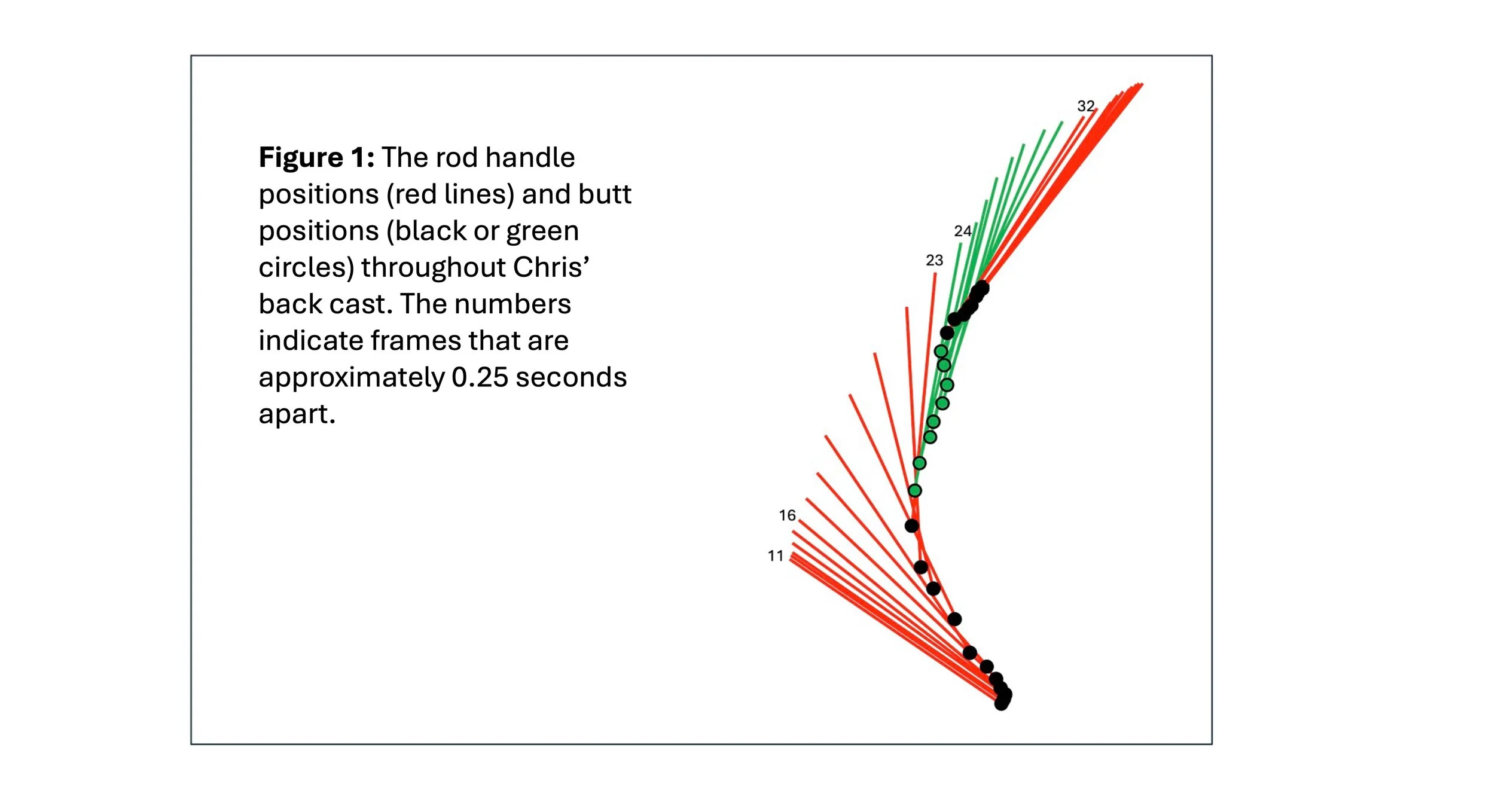
One of the best casters in the world is Chris Korich. His back cast for a target 50 feet away gives us tremendous insight into how a tight loop is formed. I am reposting a figure from a previous discussion. See Figure 1.
For our analysis of Chris’ back cast, I want to break up the front stroke into three stages: an initial loading phase, a power snap, and a repositioning of the rod after the rod is accelerated to a stop.
I’ve talked about the loading phase in a previous post.
At the beginning of the loading phase (frames 11 to 15 of Figure 1), Chris gets slack (what little there is) out of the line.
By making the line taut to the rod, subsequent rotation of the rod during the loading phase (frames 16-18) quickly accomplishes three goals simultaneously. First, Chris uses gravity and the mass of the line to get the bend out of the rod. Second, he gets the entire fly line moving – without accelerating the line significantly. And in this case, Chris has skillfully completed the third goal, positioning the rod perpendicular to his desired trajectory… ready for the power snap. Had the rod not been at an appropriate angle for the power snap, an elite caster continues to rotate the rod until the rod is angled properly… without significantly accelerating the line.
The power snap occurs between frames 18 and 23. The arc of the power snap spans – at most – two clock hours. Two clock hours. The path of a rod tip, for a rod that will not bend much more and over such a short arc, is almost a straight line. Almost.
Consequently, when we look at Chris’ stroke, a tight loop is not necessarily a rod tip path that is perfectly straight. More importantly, it’s a power snap – for a rod that won’t bend much more – travelling over a very short arc. The key to understand is that Chris’ rod tip path creates very little acceleration perpendicular to the trajectory of the line.
At the end of the power snap, Chris does a number of things at the same time: not only does he stop the rod very quickly, but he stops it in a very high position; he also dampens the counter-flex; and finally, he repositions the rod in preparation for the next stroke before a significant length of line forms in the rod leg of the loop.
Take your time to digest the words and their meanings.
We both know that forming a tight loop is not simple. If it were, you wouldn’t be reading this post. We always hope that complicated things can be distilled into a simple statement or concept. Unfortunately, a single key for forming a tight loop would be an over-simplification of a complex process. SLP might hold some significance for casters who can already form tight loops, but it means nothing to casters who can’t.
In my next post, let’s compare how the best fly casters in the world form loops to less-skilled fly casters.
* * * * *