The shape of the loop is mostly determined by the power snap. Casters, like Chris Korich and Steve Rajeff, use their power snap to accelerate their lines – not just towards – but at a singular target in the air or on the water.
During the power snap, they want as much of the cast’s energy to be in one very specific direction for as long as possible. And this is the biggest difference between casters who can form tight loops and those who cannot. During the power snap, casters who cannot form tight loops inadvertently accelerate their lines perpendicular to the intended trajectory.
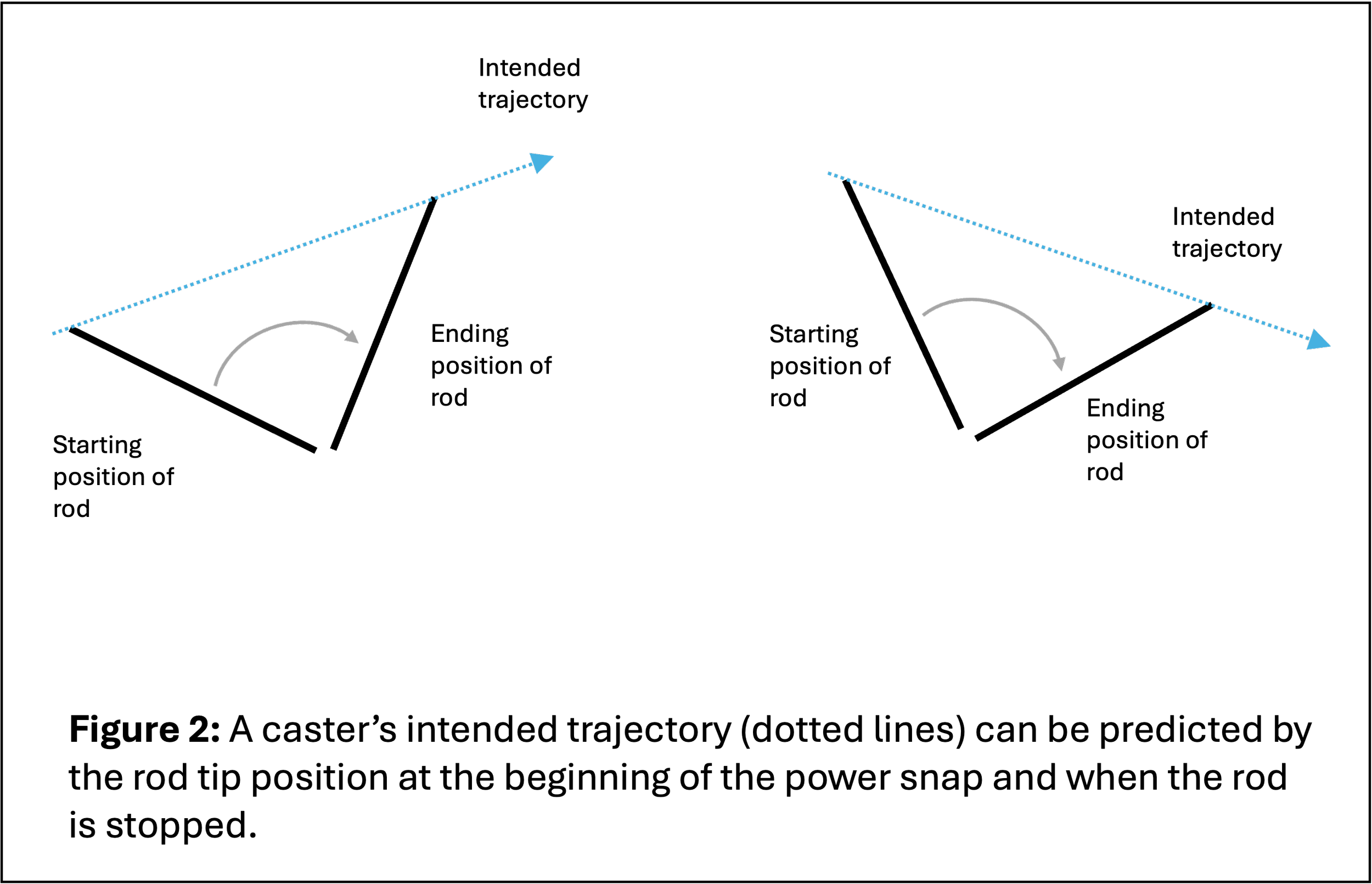
A caster’s intended trajectory can be estimated by the relative positions of the rod tip at the beginning of the power snap and when the rod is stopped. An imaginary line connecting the rod tips at these two rod positions predicts the trajectory of the cast. See Figure 2.
During Chris Korich’s back cast for a target 50 feet away, his power snap starts at approximately 10 o’clock and ends at approximately 12 o’clock. Although Figure 1 does not show the rod tip, you can see from the relative positions of the rod handle that the trajectory of the back cast is upwards – against gravity.
Power snaps for casts of shorter distances (especially front casts that have downward trajectories with gravity) should occur in less than two clock hours.
But, assuming power snaps of two clock hours, one that starts at 11 o’clock and stops at 1 o’clock will have a relatively level trajectory. A different power snap that starts at 12 o’clock and stops at 2 o’clock will have a downward trajectory.
Deviations of the rod tip path from the caster’s intended trajectory during the power snap (unlike the loading phase) profoundly affect the width of the loop. Due to the large acceleration that occurs during the power snap, deviations of the rod tip pull proportional lengths of fly line perpendicular to the trajectory of the cast, ripping the loop apart to form a wide loop or collapsing the loop to create a tail.
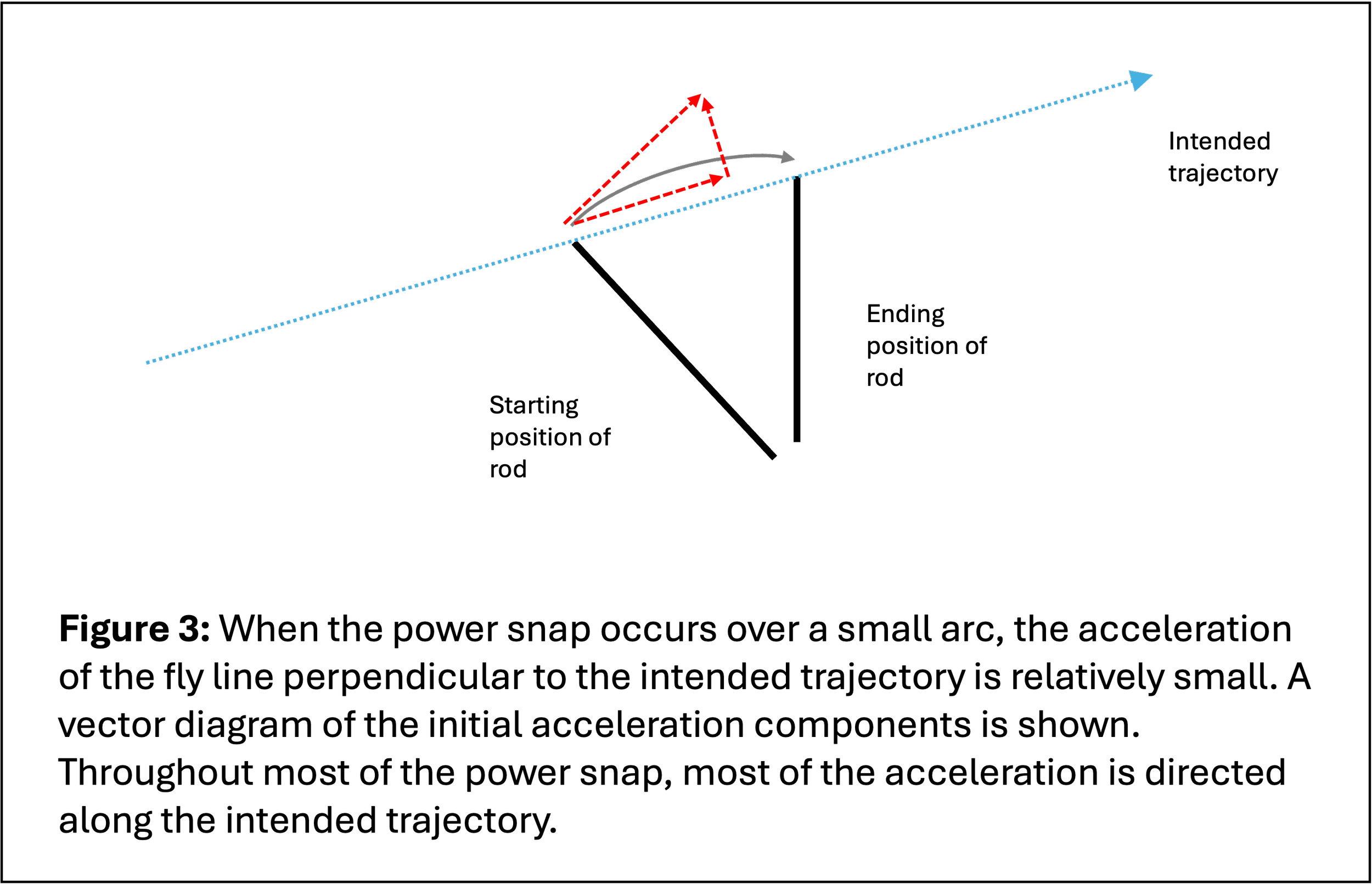
When we consider Chris’ power snap of two hours, the perpendicular component of acceleration (relative to the intended trajectory and length of line) is small. See Figure 3.
In contrast, casters who can’t form a tight loop have much longer power snaps. Imagine an ill-advised power snap that starts at 9 o’clock and stops at 3 o’clock. The starting and stopping points of the rod suggest that the intended trajectory is straight ahead.
At the beginning of this power snap, unlike Chris’ power snap, the line is accelerated mostly perpendicular to the intended trajectory with little to no energy really directed straight ahead. See Figure 4.
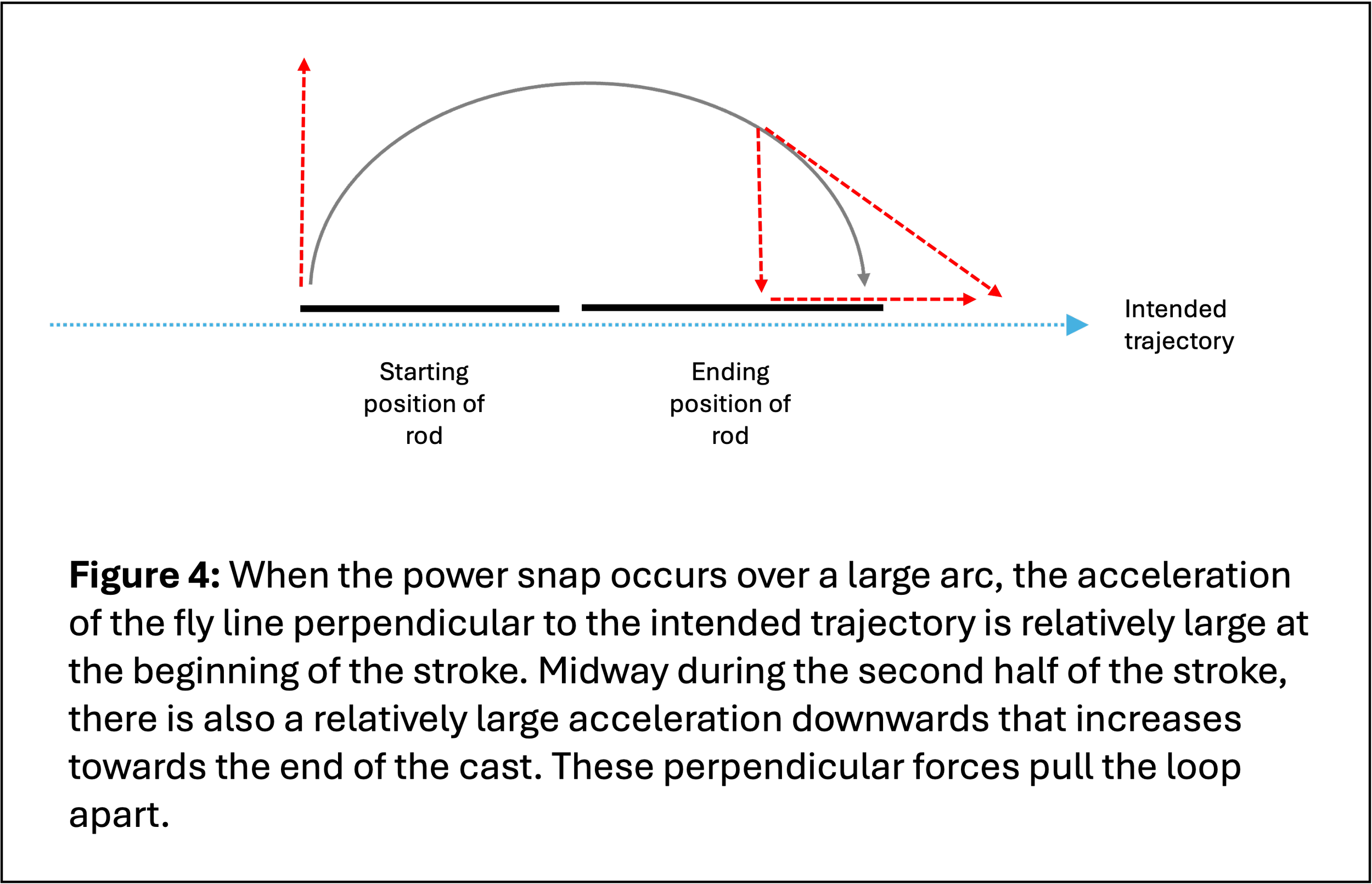
As the power snap proceeds towards 12 o’clock, the acceleration of the line increases towards the direction of the target, but it never truly aligns with the intended trajectory. However, the end of the line is still travelling upwards because the caster continues to accelerate the line upwards – albeit in a smaller magnitude.
Once the rod passes the 12 o’clock position and proceeds towards 3 o’clock, the rod starts to accelerate the line increasingly downwards… pulling the line down that was once moving upwards. At the same time, the rod tip accelerates the line along the intended trajectory less and less.
Unlike a world-class power snap where the line is accelerated along a specific trajectory most of the time, in this case, the line is accelerated with great force along the intended trajectory for only a few moments: when the rod is around vertical.
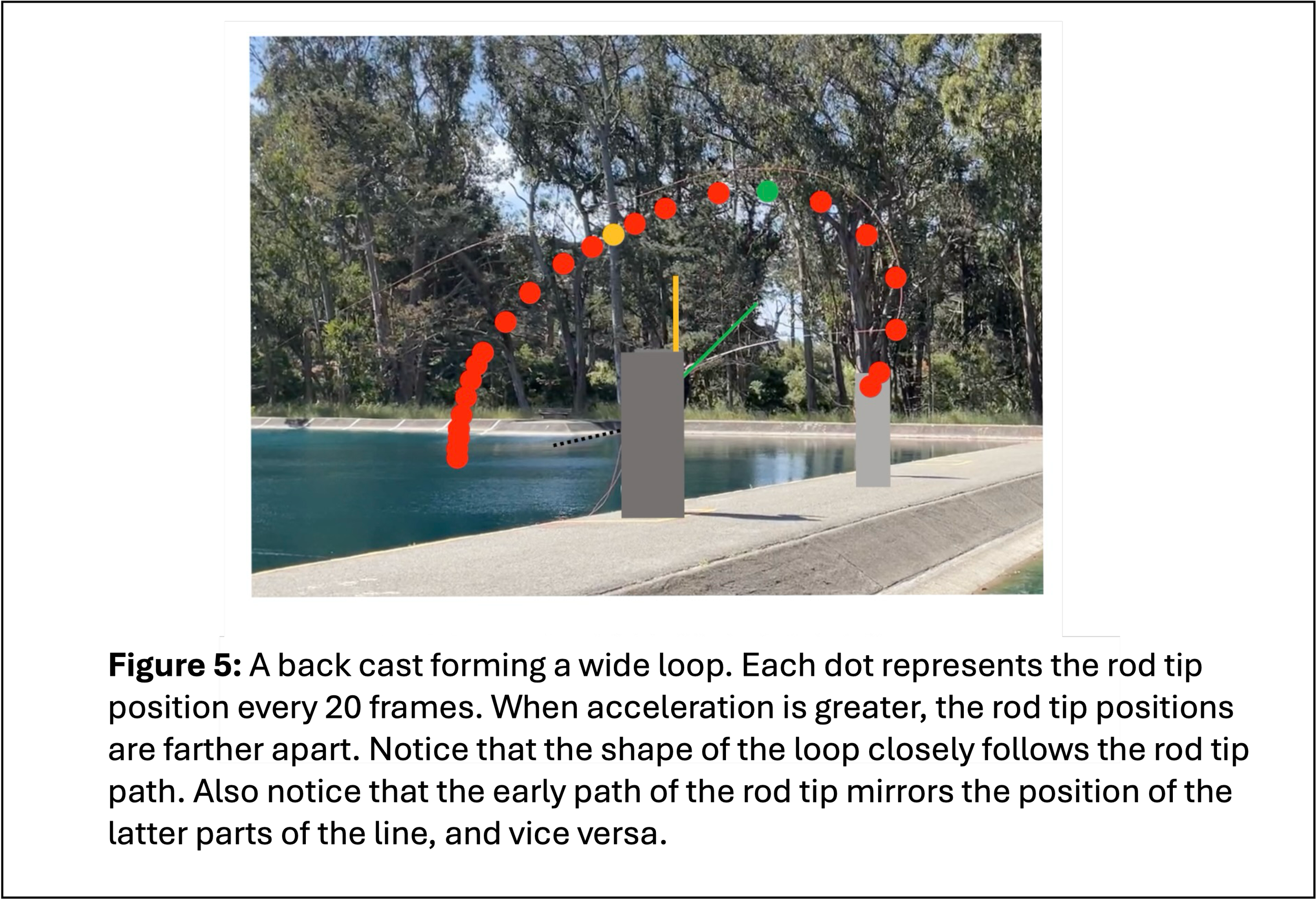
Casters who accelerate the line upwards too much during the first half of their power snap and then accelerate the line downwards too much in the second half of their power stroke are pulling their loops apart. That’s why their loops are wide. See Figure 5 (a post from a previous discussion).
And it doesn’t matter who is casting. A long power snap, whether the caster is Chris or someone who is just learning to cast, will create a big loop. It’s just physics. It has nothing to do with skill.
The difference is that Chris knows not to use such a long power snap. By mitigating his perpendicular accelerations (from the intended trajectory), his loops remain tight. This is why the literature advocates for a straight-line rod tip path. A straight-line rod tip path has no vertical deviations. And it may be a useful concept for competitive distance casting, but not for fishing casts.
Since it is extremely difficult to create a straight-line rod tip path when you rotate the rod, it’s easier to keep the arc of your power snap as small as possible – after you have gotten the bend out of the rod.
* * * * *