Rotation Versus Translation
In this blog, I have emphasized rotation. Afterall, fly casting is a rotation of the rod. At the beginning of a cast, the rod is angled away from the target, and at the end of the cast, the rod is angled toward it. The only way to accomplish this change is to rotate the rod.
Although it may not be obvious, translation is an extreme form of rotation. When a rod translates, the center of its rotation is an infinite distance away. And because the center of rotation is so remote, the angle of the rod does not change.
In other words, translation is a type of rotation where no rotation occurs.
If translation is the most inefficient form of rotation, then rotating the rod near the rod hand would be one of the most efficient. When the rod’s center of rotation is near the rod hand, small movements can change the position of the rod tip greatly. For example, a one-centimeter change in a caster’s thumb position can change the tip position of a 9-foot rod by 10 centimeters.
As the rod’s center of rotation is moved away from the rod hand, one-centimeter changes in the caster’s thumb position change the position of the rod tip more than one centimeter but less than 10 centimeters. Eventually, when the rod’s center of rotation is a sufficient distance away, a one-centimeter change in a caster’s thumb position will change the tip position by only one centimeter. This is when rotation is better known as translation.
The Role of Translation Before The Power Snap
It is very difficult to cast a length of fly line when the angle of the rod stays fixed. Translation of the rod, unlike more efficient forms of rotation, does not take advantage of the rod’s length by turning it into a lever. Nevertheless, translation plays an important role before the power snap. If we don’t translate the rod to remove slack and get the entire line moving in the desired direction, rotation of the rod would be useless.
The word, “useless,” might be a bit melodramatic, but rotating the rod becomes less effective. If we rotate the rod to remove slack, we waste part of the stroke. Moreover, slack prevents tension on the rod tip (versus a line straightening out… pulling on the rod tip), and consequently, the rod rotates more quickly… accelerates faster… despite the caster applying the same force. And once slack is removed, the sudden tension (and mass) of the line on the rod tip causes the tip path to deflect downward creating a tail.
Often, the caster is perplexed. I didn’t do anything differently. Why did that cast form a tail?
Rotating the rod to remove slack can create tailing loops in other ways. It can also affect the trajectory of the cast. Although rotating the rod is a more efficient way of removing slack (compared to translation), it is better to remove slack by translation (compared to rotation).
The Role of Translation During The Power Snap
To summarize the previous section, we want to remove slack by translation for two main reasons. First, we want to save more efficient forms of rotation… that change the rod angle… for the power snap. And second, translation is less likely to lead to tailing loops (compared to rotation).
Translation can also play an important role during the power snap.
One of the most obvious benefits of translation during the power snap is that it can increase rod tip velocity. However, there is another, more subtle, advantage.
I think that most of us can agree that the length of the power snap should be proportional to the length of line being cast: longer line, longer arc… shorter line, shorter arc.
If a power snap occurs by rotation only, then the center of the rod’s rotation would be approximately where the rod was held by the caster. See Figure 1. A rod that is rotated without any translation defines the shortest arc that carries a certain amount of line.
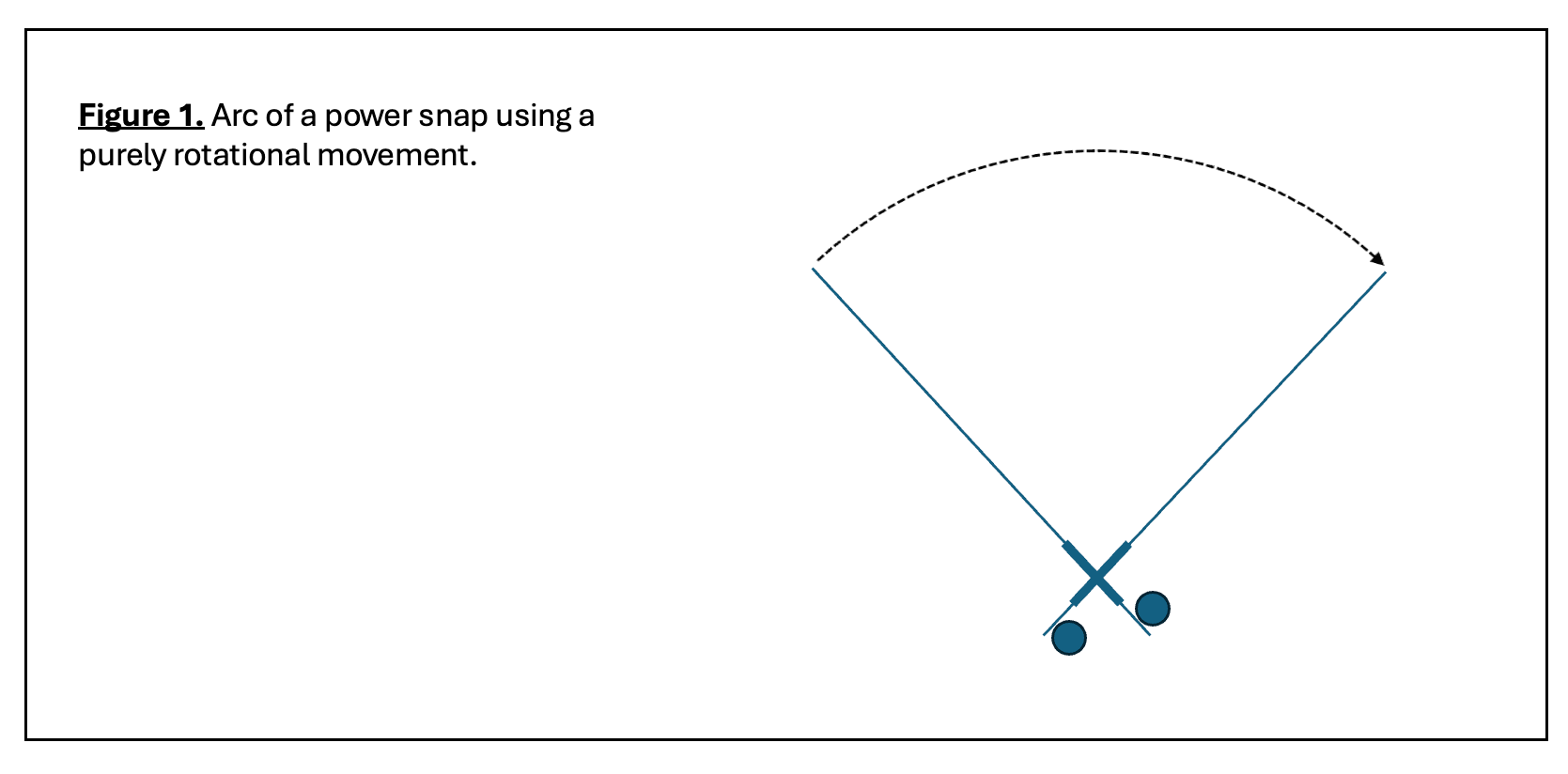
If the rod’s center of rotation does not change, larger rotations can create higher velocities to cast longer lengths of line, but they also create more arcuate (less linear) rod tip paths. Since larger arcs of the same circle have greater sagitta (or height), they will create wider loops. Consequently, in the absence of translation, short casts will have tighter loops than long ones.
In contrast, translation, by itself, invariably creates very linear rod tip paths and low tip velocities. If we used only translation during the power snap, we wouldn’t be able to make long casts, but the linear path of the rod tip would ensure extremely tight loops.
If we rotate the rod from the same starting angle to the same ending angle but now we also translate during the power snap, the rod tip traces an arc of a circle with a larger diameter compared to the previous scenario without translation. With or without translation, the sagitta (or height) of the arc would be the same, but translation elongates or stretches the arcuate path of the rod tip. Figure 2. Translation causes the center of the rod’s rotation and the center of the arcuate path of the rod tip to move downward, but to different locations (separated by the distance of translation).
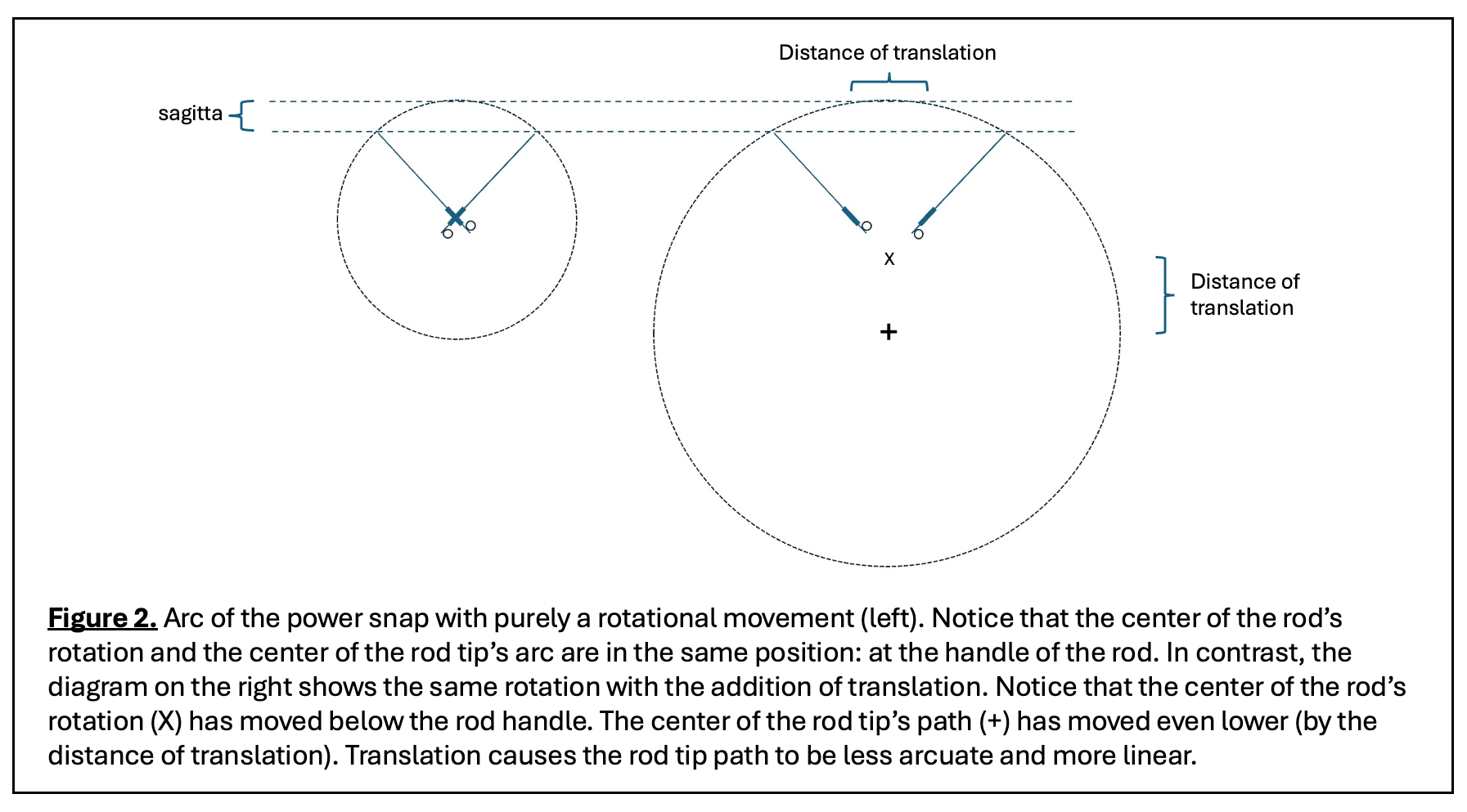
The farther the center of the rod tip’s arc moves below the rod handle, the less arcuate (more linear) the path of the rod tip. Consequently, if we combine larger translations with rotation for longer casts, we can create tighter loops compared to similar casts with only rotation.
Epilogue
At the US Casting Team practice in Long Beach last month, I saw Chris for the first time in several months. He kicked my feet apart with his foot, scolding me, “Get your feet apart!” How many times do I have to remind you?”
Since the beginning, he has always (ALWAYS) told me that spreading my feet apart will naturally lead to a weight shift. As I make a conscious effort to spread my feet apart to weight shift during my accuracy rounds, I have noticed that my line velocity has increased and that my loops have gotten slightly tighter… especially for the far targets. Since I don’t need increased line velocity for accuracy, I can use less rotation and/or force… which translates (excuse the pun) to even tighter loops.
There are many ways to form a tight loop, but they differ in their efficiency. In the same way, there are many ways to rotate the rod, and some will be more efficient than others. Although translation is the least efficient form of rotation, it still plays an important role in fly casting.
* * * * *